
If you’ve spent any time researching how to grow a business online, you’ve probably run into two terms that get thrown around almost interchangeably: performance marketing and digital marketing. Business owners, marketing beginners, and even some agencies use these words loosely, which creates a lot of confusion.
Here’s the truth: performance marketing is not a separate universe from digital marketing — it’s a subset of it. Understanding the relationship between the two, and where they differ in strategy, cost structure, and outcomes, can completely change how you plan your marketing budget and measure success.
In this guide, we’ll break down performance marketing vs digital marketing in plain language, covering definitions, channels, pricing models, pros and cons, and how to decide which approach (or combination) is right for your business.
What Is Digital Marketing?
Digital marketing is the umbrella term for any marketing effort that uses the internet or digital devices to reach an audience. It includes a wide range of strategies designed not just to drive immediate sales, but also to build brand awareness, nurture relationships, and establish long-term authority in a market.
Digital marketing typically includes:
- Search engine marketing – Enhancing a website’s organic search engine presence is known as search engine optimization, or SEO.
- Content Marketing — blogs, videos, infographics, and guides that educate or entertain an audience
- Social Media Marketing — building a brand presence and engaging followers on platforms like Instagram, LinkedIn, and Facebook
- Email Marketing — nurturing leads and retaining customers through newsletters and campaigns
- Paid Advertising (PPC, display ads, social ads) — running paid campaigns to drive traffic and conversions
- Affiliate Marketing — partnering with third parties to promote products for a commission
- Branding and Public Relations (Digital PR) — shaping how a business is perceived online
The goal of digital marketing is broad: awareness, engagement, trust, traffic, leads, and sales — often measured over weeks, months, or even years. A brand running a digital marketing strategy might invest in SEO content that takes six months to rank, alongside a social media presence that builds community, without expecting an immediate return on every rupee spent.
What Is Performance Marketing?
Performance marketing is a specific approach within digital marketing where advertisers pay only when a measurable, predefined action occurs. That action could be a click, a lead form submission, an app install, or a completed sale.
In other words, performance marketing is digital marketing with a laser focus on accountability and immediate, trackable ROI. Every rupee spent is tied to a specific, quantifiable outcome.
Common performance marketing channels include:
- Pay-Per-Click (PPC) advertising (Google Ads, Bing Ads)
- Social media ads with conversion tracking (Meta Ads, LinkedIn Ads)
- Affiliate marketing (technically also part of broader digital marketing, but performance-based by nature)
- Influencer marketing with performance-based payouts
- Retargeting and remarketing campaigns
- Native advertising with cost-per-action pricing
Performance marketing pricing models typically include:
- CPC (Cost Per Clik) — When someone clicks on your advertisement, you are charged CPC (Cost Per Click).
- CPA (Cost Per Acquisition) — you pay when a lead or sale is generated
- CPL (Cost Per Lead) — you pay when someone submits their information
- CPM (Cost Per Mille/Thousand Impressions) — less common in pure performance marketing, but still used for brand-focused performance campaigns
Because performance marketing is so tightly measured, it’s popular among businesses that want to see immediate, calculable returns rather than long-term brand equity.
Performance Marketing vs Digital Marketing: Key Differences
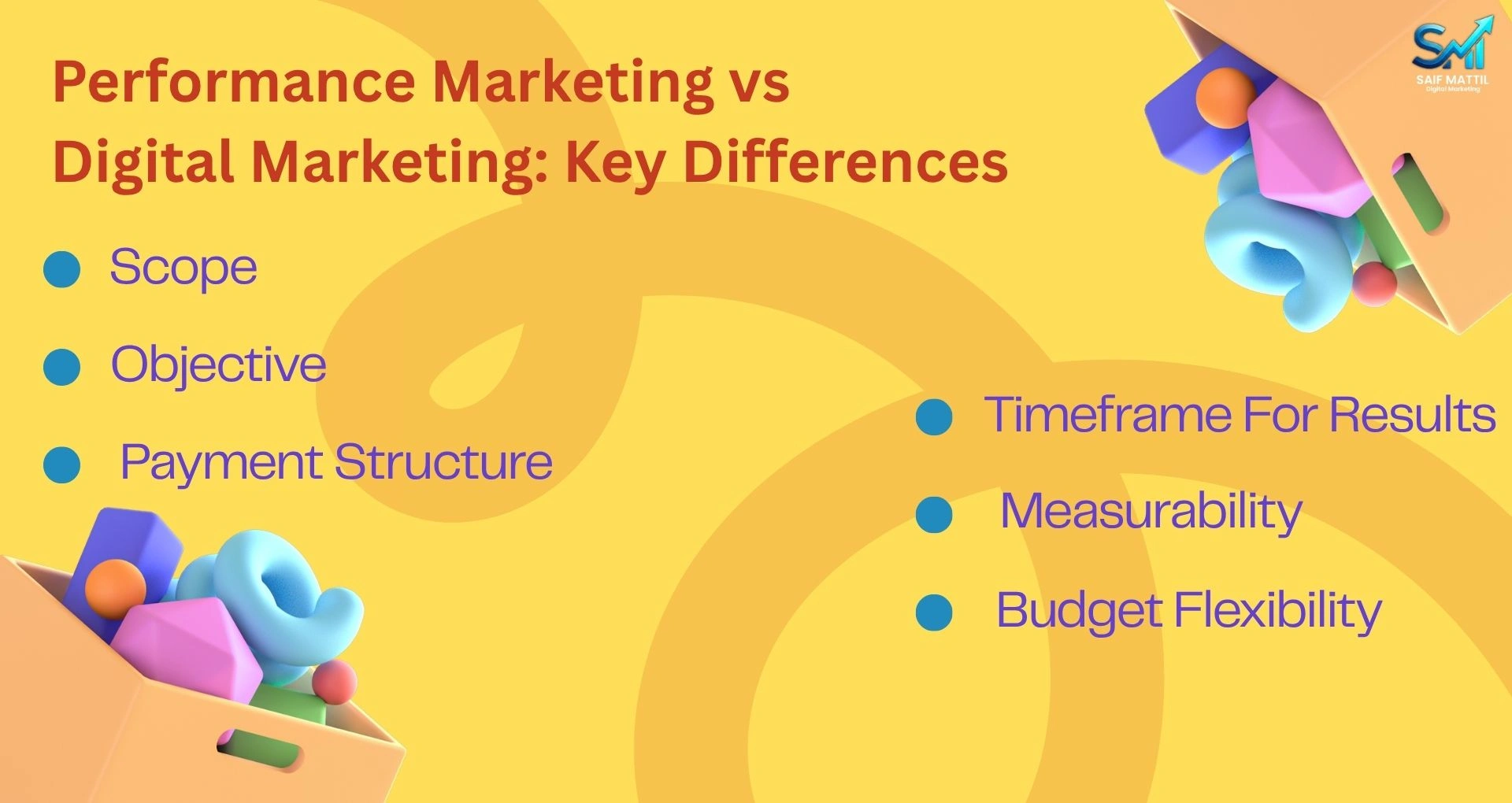
Let’s break the comparison down across the factors that matter most.
1. Scope
Digital marketing is the big picture — it covers every online marketing activity a brand undertakes. Performance marketing is one slice of that picture, focused specifically on paid, results-driven campaigns.
Think of digital marketing as the entire toolbox, and performance marketing as one particular tool inside it — a highly efficient one, but not the only one.
2. Objective
Digital marketing often serves multiple goals simultaneously: brand awareness, community building, thought leadership, SEO rankings, and customer loyalty, alongside direct sales.
Performance marketing has one primary objective: generate a specific, measurable action — usually a conversion — as efficiently as possible.
3. Payment Structure
This is one of the clearest differences. In many digital marketing activities (like organic social media or SEO), you’re investing time and resources without a direct “pay-per-result” structure. You might spend a month producing content and see no immediate return.
In performance marketing, you generally pay only when the desired action happens. This shifts financial risk away from the advertiser and onto the platform or publisher, since you’re not paying for impressions or attention that don’t convert.
4. Timeframe for Results
Digital marketing strategies like SEO and content marketing are long-term plays. It can take months to see meaningful organic traffic growth, but the results tend to compound and remain relatively stable over time.
Performance marketing delivers faster, more immediate results. Launch a Google Ads campaign today, and you can start seeing clicks and conversions within hours. However, results often stop the moment you stop paying — there’s little residual value once the campaign ends.
5. Measurability
Digital marketing as a whole is measurable, but some elements (like brand awareness or PR impact) are harder to quantify precisely. Metrics like “brand sentiment” or “share of voice” are useful but somewhat abstract.
Performance marketing is built entirely around measurable metrics: click-through rate, cost per acquisition, conversion rate, return on ad spend (ROAS). Everything is trackable, attributable, and optimizable in near real-time.
6. Budget Flexibility
Digital marketing budgets often need to be committed upfront for content creation, SEO tools, or agency retainers, regardless of short-term outcomes.
Performance marketing budgets are more flexible — you can scale spending up or down almost instantly based on what’s working, since you’re only paying for actual results.
Performance Marketing vs Digital Marketing: A Side-by-Side Summary
| Factor | Digital Marketing | Performance Marketing |
| Scope | Broad umbrella term | Subset focused on paid, trackable actions |
| Primary Goal | Awareness, engagement, and sales | Immediate, measurable conversions |
| Payment Model | Mixed (time, retainers, ad spend) | Pay-per-result (CPC, CPA, CPL) |
| Timeframe | Long-term, compounding | Short-term, immediate |
| Measurability | Partial (some metrics are qualitative) | Fully trackable and attributable |
| Risk | Shared between effort and outcome | Lower financial risk, tied to results |
| Examples | SEO, content, branding, social presence | PPC, paid social, affiliate, retargeting |
Which One Should You Choose?
This is usually the wrong question to ask, because it’s rarely an either/or decision. The smartest marketing strategies use performance marketing within a broader digital marketing framework.
Here’s a practical way to think about it:
If you need fast, measurable results (like immediate leads for a product launch or seasonal sales), performance marketing channels like PPC or paid social ads are your best bet. You’ll see quick data on what’s working and can optimize on the fly.
If you’re building a brand for the long haul, you need the full digital marketing mix — SEO, content, organic social, email nurturing — even though the payoff takes longer to materialize. This groundwork also makes your performance marketing campaigns more effective over time, since a stronger brand and better-optimized website will convert paid traffic more efficiently.
Most successful businesses blend both. For example, a company might run performance marketing campaigns to generate immediate leads while simultaneously investing in SEO and content marketing to reduce dependency on paid ads over time. As organic visibility grows, the cost of paid acquisition often drops too, because the brand becomes more recognizable and trustworthy.
Common Myths About Performance Marketing vs Digital Marketing
Myth 1: Performance marketing is “better” than digital marketing. This isn’t accurate — performance marketing is a component of digital marketing, not a competitor to it. Comparing them as equals is like comparing a car to its engine.
Myth 2: Digital marketing without performance marketing doesn’t work. Organic strategies like SEO and content marketing can absolutely drive significant business results, though they typically take longer to show measurable ROI.
Myth 3: Performance marketing guarantees profitability. Just because a campaign is trackable doesn’t mean it’s automatically profitable. Poor targeting, weak creatives, or a mismatched offer can burn through ad spend quickly, even with excellent tracking in place.
Myth 4: You need a huge budget to start performance marketing. Many platforms allow small daily budgets, making performance marketing accessible even for small businesses and freelancers testing the waters.
How to Get Started
If you’re a business owner or freelancer trying to figure out where to begin, here’s a simple roadmap:
- Define your goals first. Are you looking for brand awareness, long-term traffic, or immediate leads/sales? Your answer determines the mix of strategies you need.
- Set up tracking before you spend. Whether it’s Google Analytics, Meta Pixel, or a CRM, you need clean data to measure performance marketing accurately.
- Start small with performance marketing. Test a modest PPC or paid social budget, track results closely, and scale what works.
- Invest in digital marketing fundamentals in parallel. Even while running paid campaigns, build your website’s SEO foundation and start creating valuable content — this pays dividends long after ad campaigns end.
- Review and optimize regularly. Digital marketing and performance marketing both require ongoing adjustment based on real data, not guesswork.
Frequently Asked Questions
1. What is the difference between digital marketing and performance marketing?
Digital marketing is the broader strategy, while performance marketing focuses on measurable, results-driven actions such as clicks, leads, and sales.
2. Is performance marketing a part of digital marketing?
Yes. Performance marketing is a subset of digital marketing focused on paid and trackable campaigns.
3. Which one gives faster results?
Performance marketing generally provides faster results, while strategies such as SEO and content marketing usually take longer to produce meaningful results.
4. Does performance marketing require a large budget?
No. Many platforms allow businesses to start with small daily budgets and increase spending as campaigns prove successful.
5. Should a business choose digital marketing or performance marketing?
Businesses generally benefit from using both. Performance marketing can generate quick results, while SEO, content, social media, and other digital marketing strategies help build long-term growth.
Final Thoughts
The performance marketing vs digital marketing debate isn’t really a debate at all — it’s a matter of understanding how one fits inside the other. Digital marketing is the complete strategy for building an online presence, while performance marketing is the results-driven engine that delivers fast, measurable outcomes within that strategy.
The businesses that grow fastest and most sustainably are the ones that don’t pick a side. They use performance marketing to generate quick wins and cash flow, while steadily building the broader digital marketing foundation — SEO, content, brand trust — that keeps costs down and results compounding over time.
Whether you’re just starting out or refining an existing strategy, the key takeaway is simple: don’t think of performance marketing and digital marketing as competitors. Think of them as two gears in the same machine, working together to drive real, sustainable growth.