
If you run ads on Facebook or Instagram and you have noticed your campaigns behaving differently over the past year — audiences that used to convert reliably suddenly going quiet, creative burning out faster, and old “best practices” simply not working the way they used to — you are not imagining things. The reason has a name: Andromeda, Meta’s rebuilt ad-retrieval engine, and understanding the Meta Andromeda update is now essential for anyone serious about paid social.
This isn’t a small tweak buried in the Ads Manager settings. It is a ground-up rebuild of how Meta decides which ads even get a chance to compete for your attention. In this post, we will break down what the Meta Andromeda update actually is, how it evolved, what it changes for advertisers, and — most importantly — what you should be doing differently right now to keep your campaigns performing, now that the Meta Andromeda update is fully rolled out.
What Is the Meta Andromeda Update?
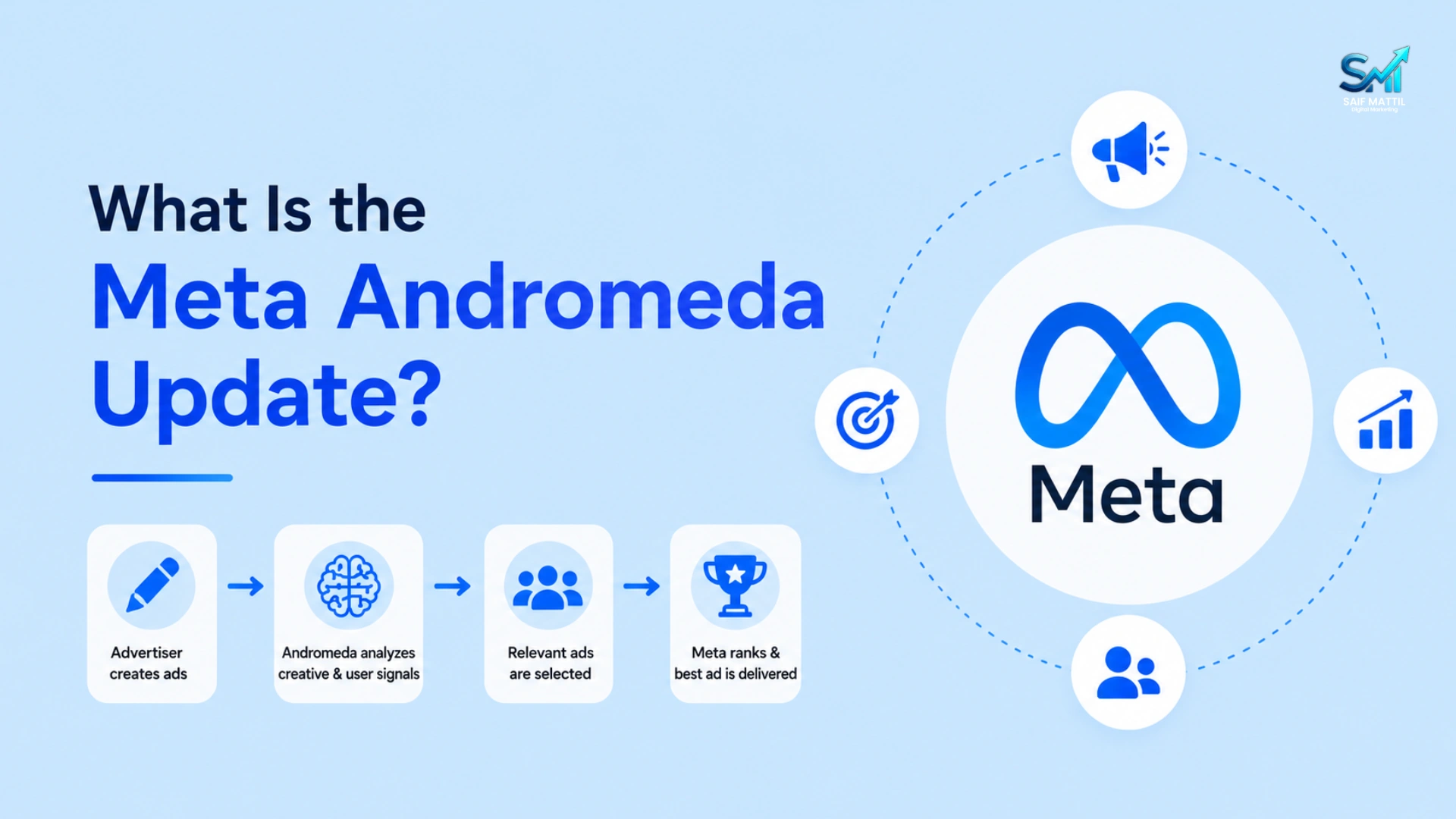
Andromeda is the internal name for Meta’s next-generation ads retrieval system. In plain terms, “retrieval” is the very first stage of the ad auction — the moment Meta narrows down millions of possible ads to the small pool of candidates that will actually be evaluated and shown to a specific person. Before an ad can win a bid, it first has to survive retrieval, and Andromeda is the system that decides who makes that cut. This meta andromeda update marks one of the biggest shifts in how ad retrieval works.
Historically, this stage leaned heavily on advertiser-defined signals: interests, demographics, lookalike audiences, and behavioral buckets that marketers built by hand. The meta andromeda update flips that model. Instead of relying primarily on the audience you define, it reads the ad itself — the imagery, video hooks, copy, and format — and uses that creative content, combined with real-time behavioral prediction, to determine who is likely to respond. Meta’s underlying AI models (often referred to internally as GEM) analyze creative and user behavior together to predict, person by person, which ad is the best match.
The result is a system that behaves less like a targeting dial you turn and more like a curator that is constantly learning from the creative you feed it. Advertisers watching for this meta andromeda update should expect creative quality to matter more than manual audience targeting going forward.
A Quick Timeline of the Rollout
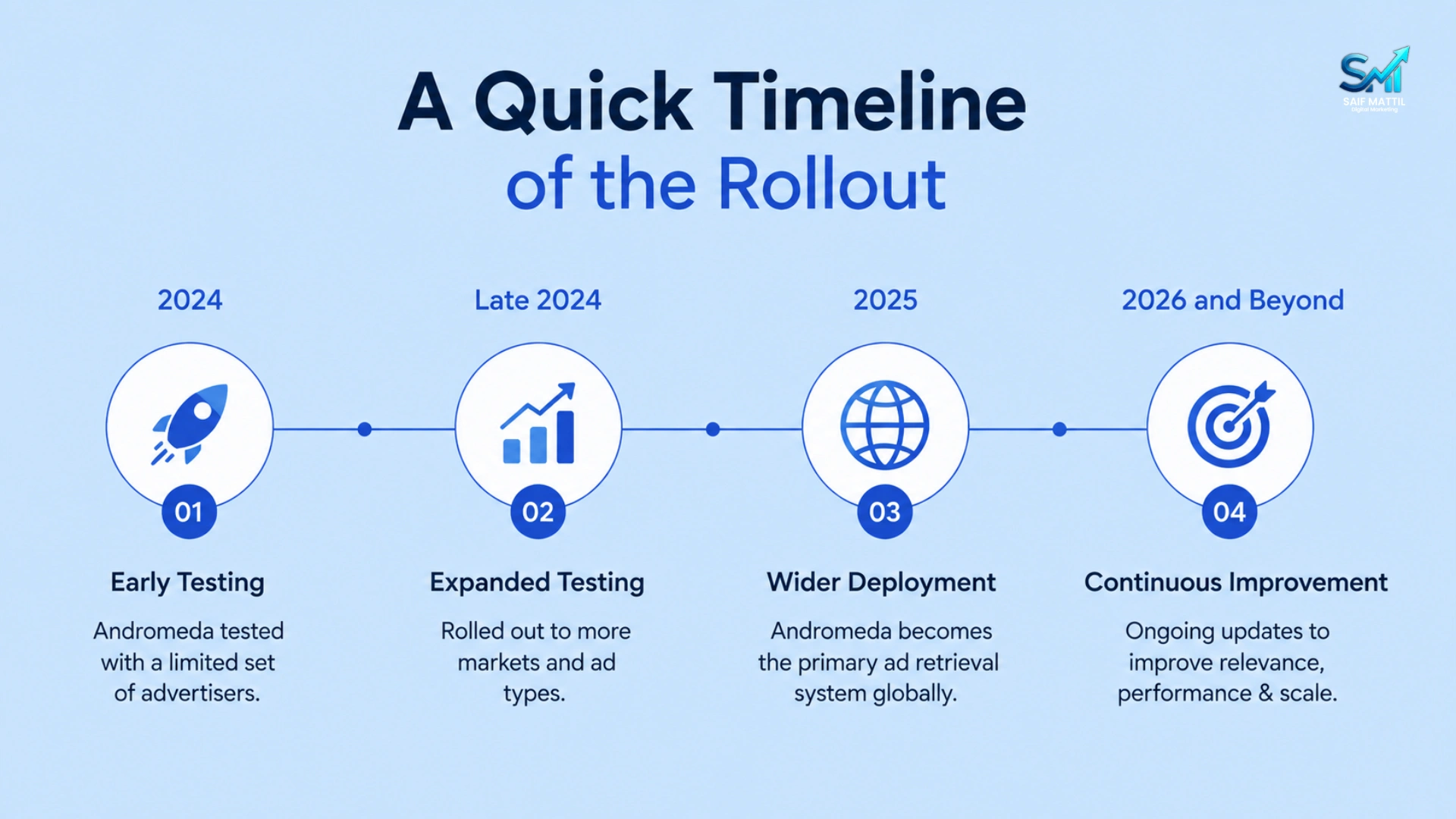
Understanding why Andromeda feels so disruptive is easier once you see how it unfolded:
- December 2024 — Meta quietly introduced Andromeda through its engineering blog, describing it as a next-generation personalized ads retrieval engine designed to strengthen its Advantage+ automation suite.
- Early to mid-2025 — Andromeda began rolling out gradually across campaign objectives and placements. Advertisers started noticing that broad, loosely defined delivery was starting to outperform tightly built audience stacks, and that creative quality was explaining more of the swings in performance than targeting choices were.
- October 2025 — By most industry observation, Andromeda had become globally active across the majority of campaign objectives and placements on Facebook, Instagram, and Messenger.
- Late 2025 into January 2026 — Andromeda became the default behavior behind essentially every Meta campaign, and Meta accelerated the removal of several legacy manual controls in favor of a more automated, “goal-only” style of campaign setup. This shift, often referred to as the meta andromeda update, so while the system has technically existed for over a year, most advertisers only started to feel its full effect in the first half of 2026, once it became the baseline experience rather than a gradual test.
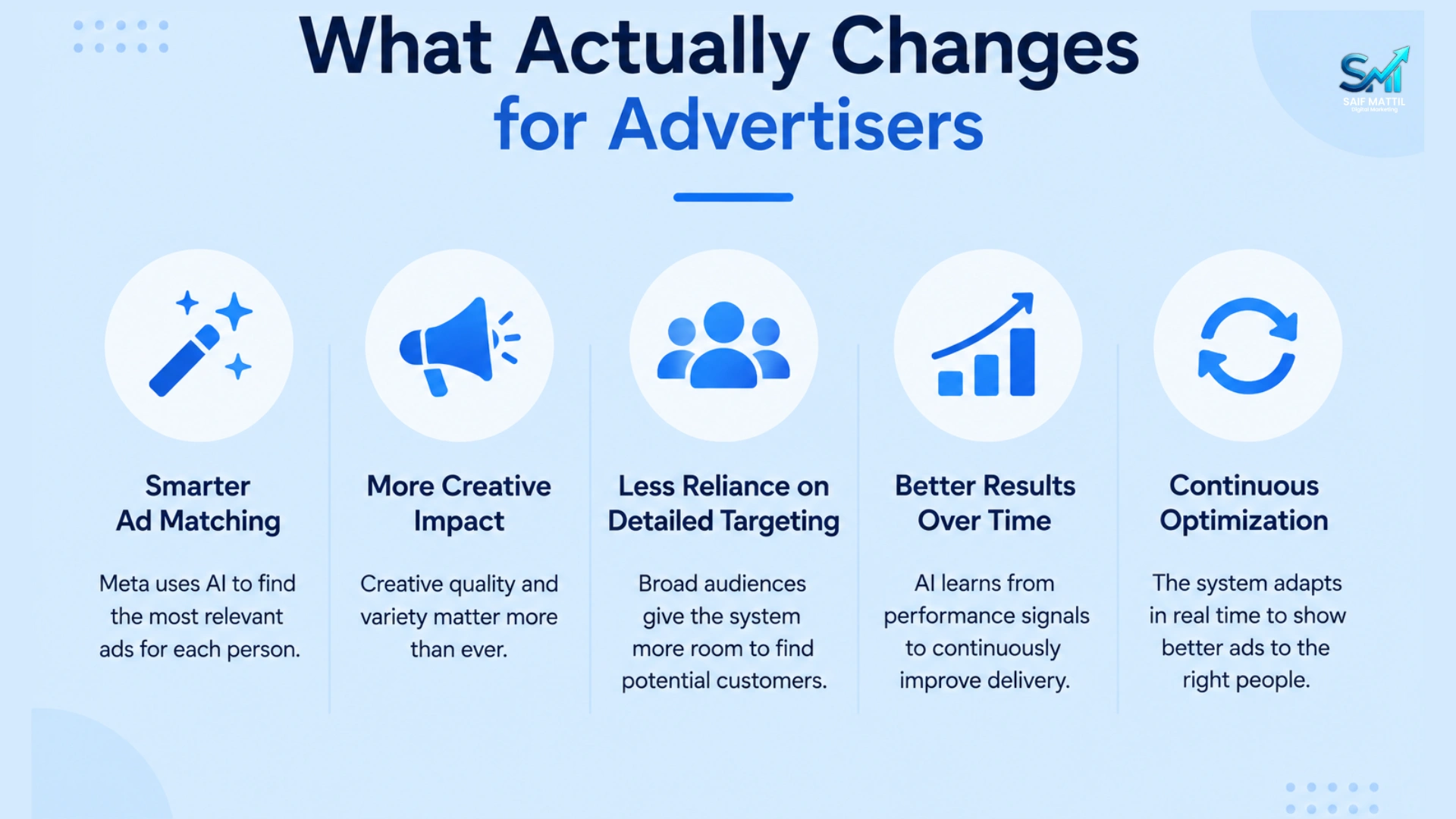
What Actually Changes for Advertisers
1. Creative Is the New Targeting
This is the single biggest shift brought by the Meta Andromeda update. Under Andromeda, the visuals, messaging, hooks, and formats inside your ad are read by the system and used to match your ad to the people most likely to respond — before your traditional targeting settings even come into play. Interest stacks, narrow demographic filters, and layered lookalike audiences no longer move the needle the way they once did. If your creative is generic or thin, no amount of clever audience-building will compensate.
2. Simpler Campaign Structures Win
Fragmented campaigns with many small ad sets used to give advertisers a feeling of control. Under the Meta Andromeda update, that fragmentation actively works against you. Splitting your budget across many narrow ad sets slows down the system’s ability to learn, because each ad set gets fewer data points to work with. Consolidated structures — fewer ad sets, more creative variations feeding into each one — tend to let the algorithm find winning combinations faster and more reliably.
3. Signal Quality Matters More Than Ever
Andromeda’s predictions are only as good as the data it receives. That makes your Meta Pixel and Conversions API (CAPI) setup, your Event Match Quality score, and having a single, clearly prioritized conversion event more important than they have ever been — a core theme of the Meta Andromeda update. Weak or duplicated signals don’t just create reporting headaches anymore — they directly degrade how well the retrieval engine can find your best customers.
4. Delivery Moves Faster, and So Does Fatigue
Because Andromeda evaluates and reallocates delivery dynamically, campaigns feel more responsive — but creative also gets discovered and exhausted much faster than before. Advertisers who upload a handful of assets and expect them to run for weeks are often surprised by how quickly performance decays under the Meta Andromeda update. Meta’s system rewards continuous creative refreshes, not “set and forget” campaigns.
5. Campaign-Level ROAS Can Be Misleading
Because Andromeda shifts delivery dynamically across campaigns based on real-time signals, judging performance campaign-by-campaign can give a distorted picture. Many performance marketers adapting to the Meta Andromeda update are now leaning more on blended metrics — like total revenue divided by total ad spend across the account — to get an accurate read on what is actually working.
The Growing Pains Advertisers Are Reportin
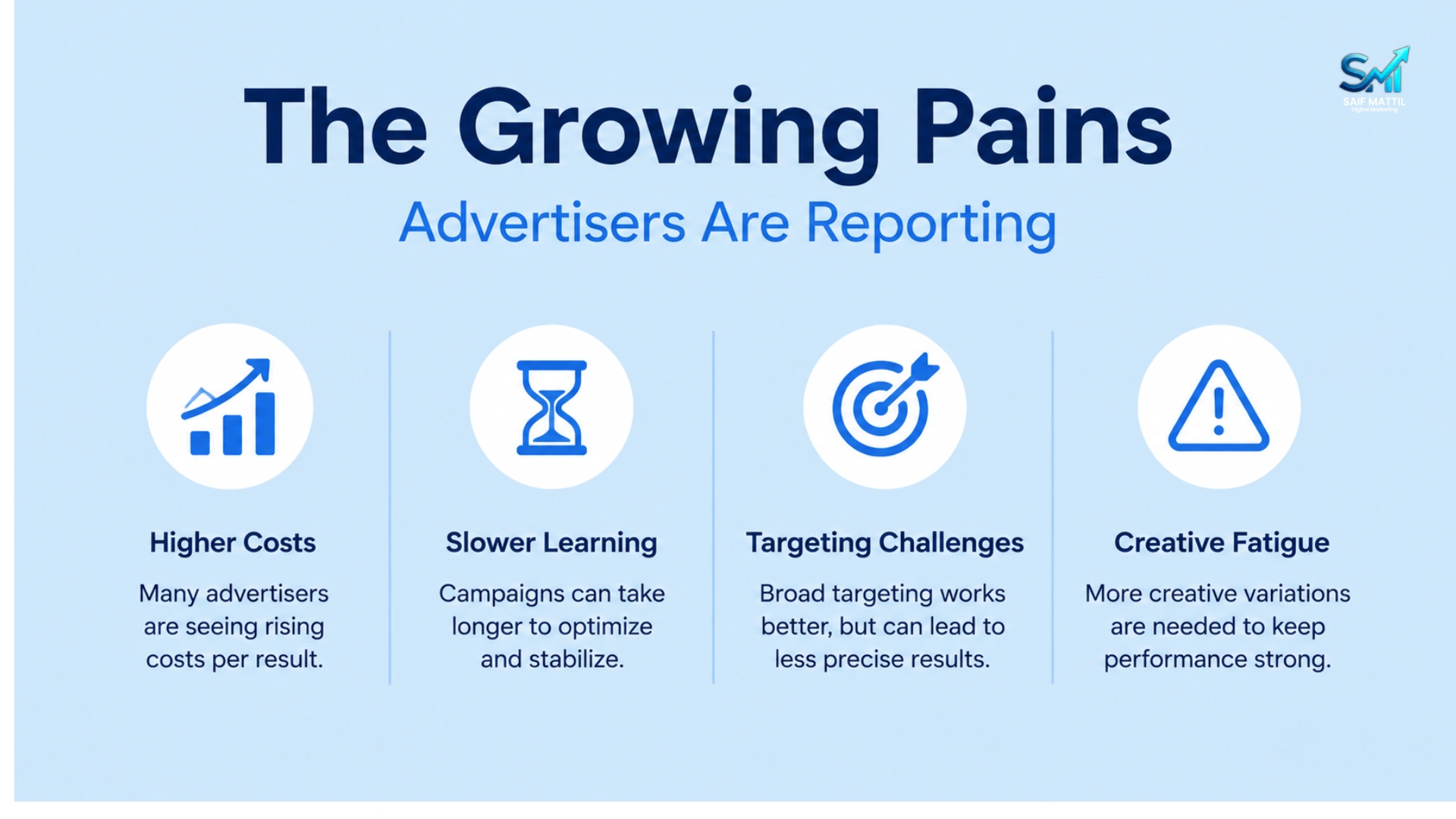
The shift hasn’t been smooth for everyone. Since the accelerated rollout in January 2026, a number of advertisers and agencies have reported issues tied to the broader push toward automation:
- Lead quality problems. With Meta’s Instant Forms becoming increasingly frictionless — helped along by aggressive auto-fill — some advertisers are seeing a spike in incomplete or accidental form submissions, where a person barely realizes they’ve submitted their information.
- Volatility that looks like instability. Because the system reacts quickly to new signals, performance swings can look alarming even when nothing is fundamentally broken. This has led to confusion among advertisers who assume something is malfunctioning when, in reality, Andromeda is simply reacting to weak creative or thin signal data.
- Over-reliance on automation. Some advertisers assume that because Andromeda is powerful and adaptive, they can simply flood it with creative volume and let automation handle everything else. In reality, the system still depends heavily on the strategic clarity of your campaign objectives, the quality of your creative assets, and the cleanliness of your data — it does not fix underlying signal or budget problems on its own.
How to Adapt Your Strategy
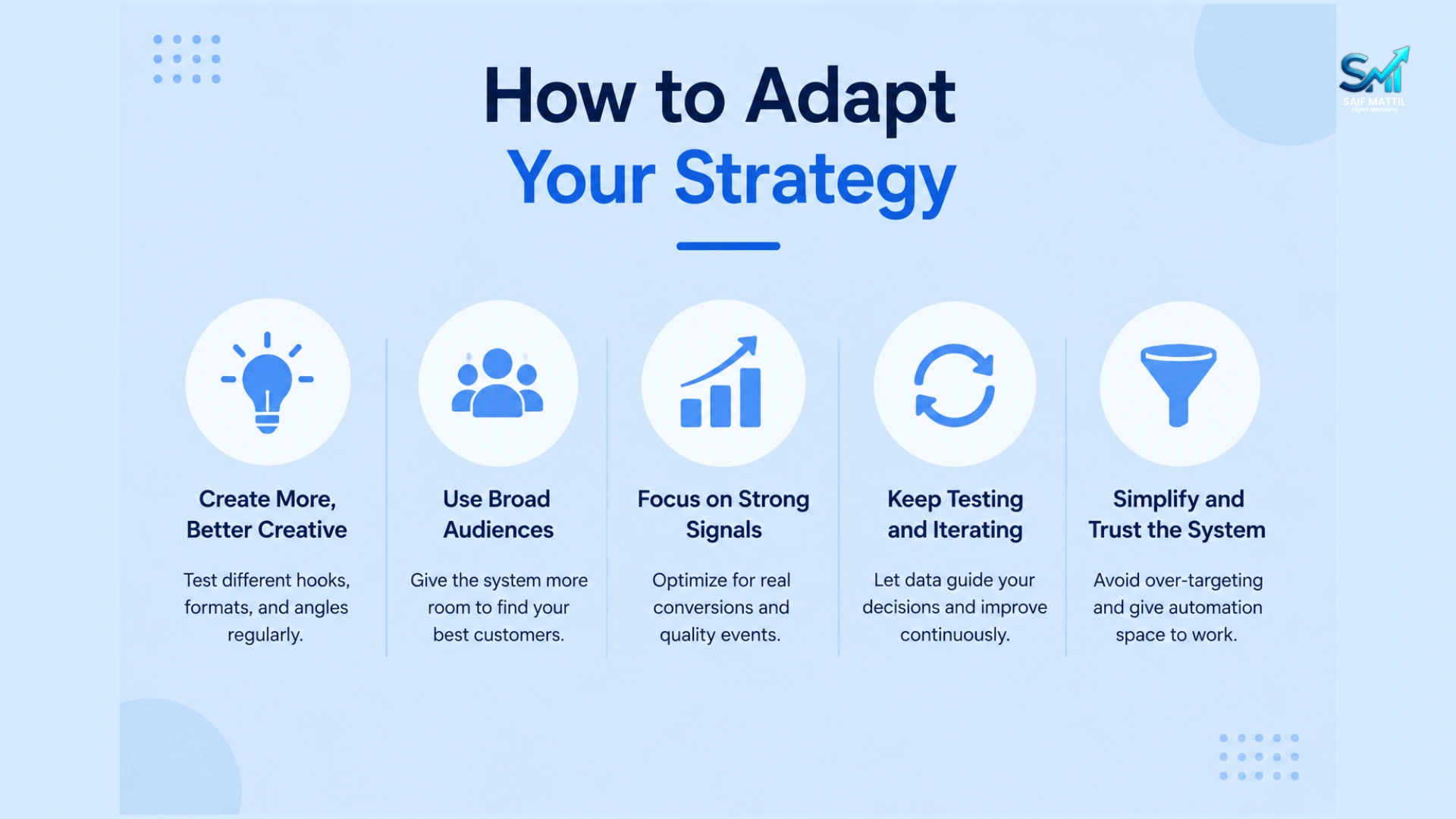
Given all of this, here is a practical playbook for advertisers navigating Meta in the post-Andromeda landscape:
- Treat creative as your primary lever, not an afterthought. Build a continuous production pipeline rather than a one-time batch of ads. Diversity in hooks, formats (video, static, carousel), and messaging angles gives the algorithm more to learn from.
- Simplify your campaign structure. Consolidate ad sets where possible and let more creative variations run within fewer, better-funded ad sets so Andromeda has enough data to optimize quickly.
- Audit your tracking setup. Confirm your Pixel and Conversions API are both firing correctly, resolve duplicate events, and prioritize a single, clear conversion event per campaign objective.
- Refresh creative on a schedule, not a whim. Monitor frequency and fatigue signals closely, and plan for regular creative rotation rather than waiting for performance to visibly decline.
- Judge performance at the account level. Track blended metrics like overall marketing efficiency ratio (MER) alongside campaign-level ROAS, since delivery can shift between campaigns in ways that make isolated numbers less reliable.
- Align your landing page with your ad creative. Because Andromeda is optimizing around the promise made in your creative, a landing page that reinforces that same message creates a stronger feedback loop the algorithm can learn from — while a mismatch quietly erodes conversion rates even when click-through looks healthy.
- Stay skeptical of “set and forget” automation. Advantage+ and Andromeda work best when paired with strong strategic input from you, not as a replacement for it.
Is Andromeda Related to Google’s Algorithm Updates?
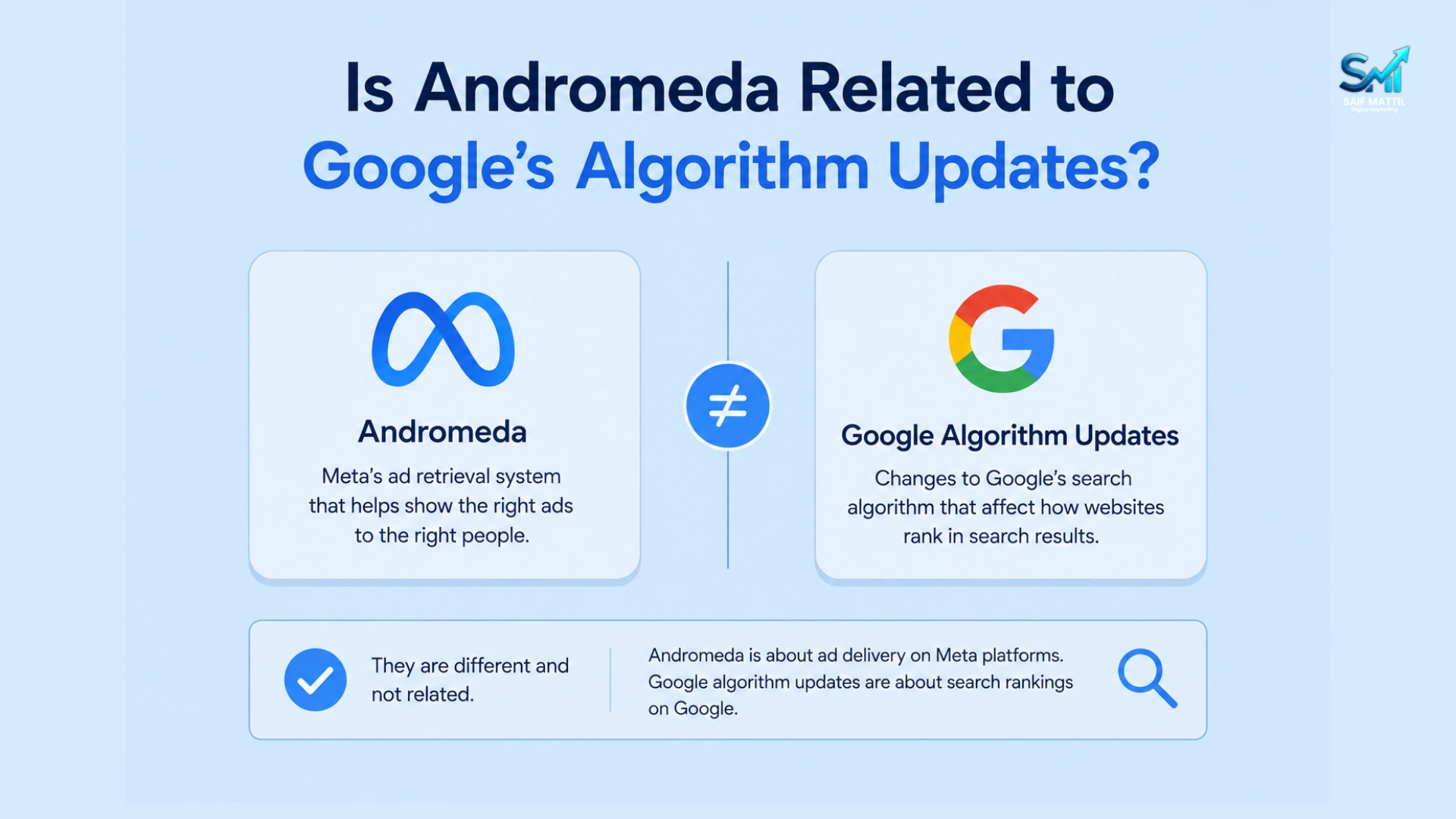
One common point of confusion is worth clearing up directly: Meta’s Andromeda has nothing to do with Google Search or Google Ads algorithm changes. They are separate companies with separate systems. If you manage both Google and Meta campaigns, it’s important not to conflate the two when diagnosing performance issues — a dip on one platform is not evidence of what’s happening on the other.
Frequently Asked Questions
1. What is the Meta Andromeda update?
Meta Andromeda is a next-generation ad retrieval system that uses AI, creative content, and user behavior to determine which ads are most relevant to each person.
2. How does Andromeda change Meta advertising?
It shifts the focus from detailed manual audience targeting toward creative quality, behavioral signals, and automated ad delivery.
3. Why is creative more important with Andromeda?
Andromeda analyzes elements such as visuals, hooks, copy, and formats to match ads with people likely to respond. Strong creative gives the system more useful signals.
4. Should advertisers use simpler campaign structures?
Yes. Consolidating ad sets and providing multiple creative variations can give Meta more data to learn from and help it optimize delivery more effectively.
5. How can advertisers adapt to the Meta Andromeda update?
Focus on continuous creative testing, clean Pixel and Conversions API tracking, simpler campaign structures, regular creative refreshes, and account-level performance measurement.
Final Thoughts
The Meta Andromeda update represents a genuine philosophical shift in how Facebook and Instagram advertising works. Meta has moved away from a world where advertisers manually define who should see an ad, toward a world where the system predicts, in real time, who is likely to respond — using your creative as the primary signal.
With the Meta Andromeda update, advertisers who adapt by investing in stronger creative pipelines, cleaner data signals, and simpler campaign structures can genuinely improve their results. Those who keep leaning on the old playbook of granular manual targeting will likely find performance continuing to feel unpredictable.
The core takeaway is simple: with the Meta Andromeda update, the algorithm isn’t just serving your audience anymore — it’s finding it. Your job as an advertiser is to give it the best possible creative and the cleanest possible signals to work with.
visit site for more Blogs