
The internet has permanently changed how brands find customers, and customers find brands. What used to happen through billboards, newspaper ads, and cold calls now happens through search engines, social feeds, email inboxes, and mobile apps. This shift has created one of the fastest-growing, most in-demand fields in the world today: digital marketing. Whether you’re a student choosing a career path, a business owner deciding where to invest your marketing budget, or a professional looking to switch industries, understanding the true scope of digital marketing is essential. In this blog, we’ll break down what the scope of digital marketing really covers, why it keeps expanding, and what opportunities it holds for individuals and businesses alike.
What Is Digital Marketing?
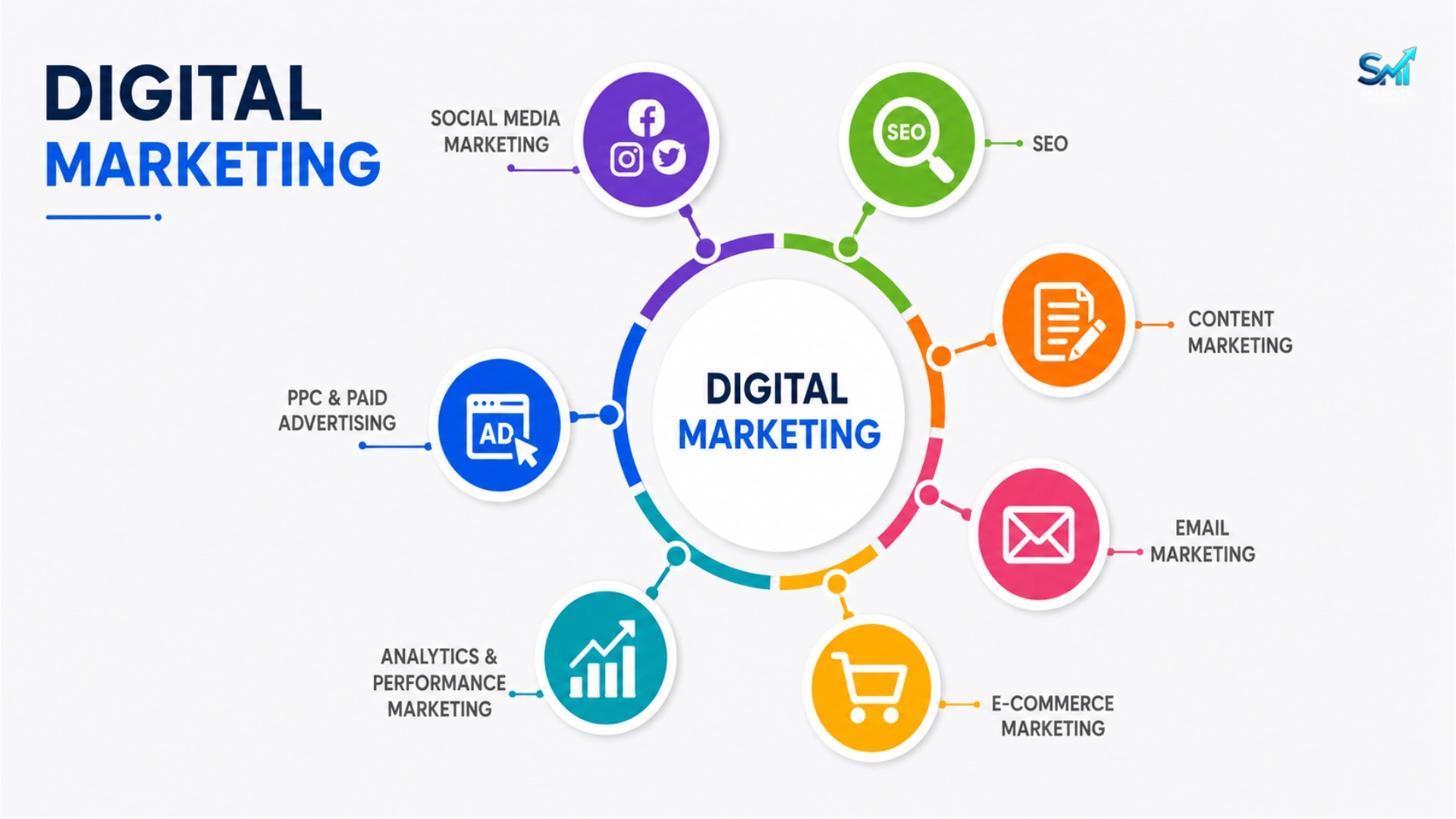
Any marketing initiative that makes use of the internet or an electronic device is referred to as digital marketing. It includes everything from search engine optimization and paid ads to social media campaigns, email newsletters, and influencer partnerships. Unlike traditional marketing, digital marketing allows businesses to target specific audiences, measure results in real time, and adjust strategies instantly based on data. This flexibility and measurability are the biggest reasons why the scope of digital marketing continues to grow year after year.
Why Digital Marketing’s Scope Is Growing
1. Increasing Internet and Smartphone Penetration
More people are online today than ever before, and that number keeps climbing. With affordable smartphones and cheaper data plans, even small towns and rural areas now have significant internet usage. This means businesses of every size, from local shops to global enterprises, need a digital presence to stay relevant. Every new internet user is a potential customer, and that alone keeps expanding the scope of digital marketing. As connectivity reaches deeper into untapped markets, the scope of digital marketing only grows wider.
2. Businesses Are Shifting Budgets from Traditional to Digital Media
Companies are moving their advertising budgets away from print, TV, and radio, and putting them into digital channels because digital marketing offers better targeting, lower costs, and measurable ROI. A small business can now run a highly targeted ad campaign for a fraction of what a newspaper ad would cost, and see exactly how many people clicked, called, or made a purchase. This shift in spending is a major driver behind why digital marketing careers and agencies are booming, and it’s a clear sign of how far the scope of digital marketing has come.
3. E-commerce Growth
Millions of individuals now regularly shop online. As e-commerce grows, so does the need for digital marketers who can drive traffic, optimize product listings, run retargeting campaigns, and convert visitors into paying customers. E-commerce brands rely almost entirely on digital marketing to survive and scale, which shows just how deeply the scope of digital marketing now extends into everyday business operations.
4. Remote Work and the Rise of the Freelance Economy
Digital marketing is one of the few careers that can be done entirely online, which makes it perfectly suited for freelancing and remote work. This has opened the field to people in smaller cities and towns who can now serve clients across the world without relocating. It has also allowed businesses to hire specialized freelance talent instead of maintaining large in-house teams, further expanding the scope of digital marketing as a service industry. This flexibility is proof that the scope of digital marketing isn’t limited by geography anymore.
Key Areas Within Digital Marketing
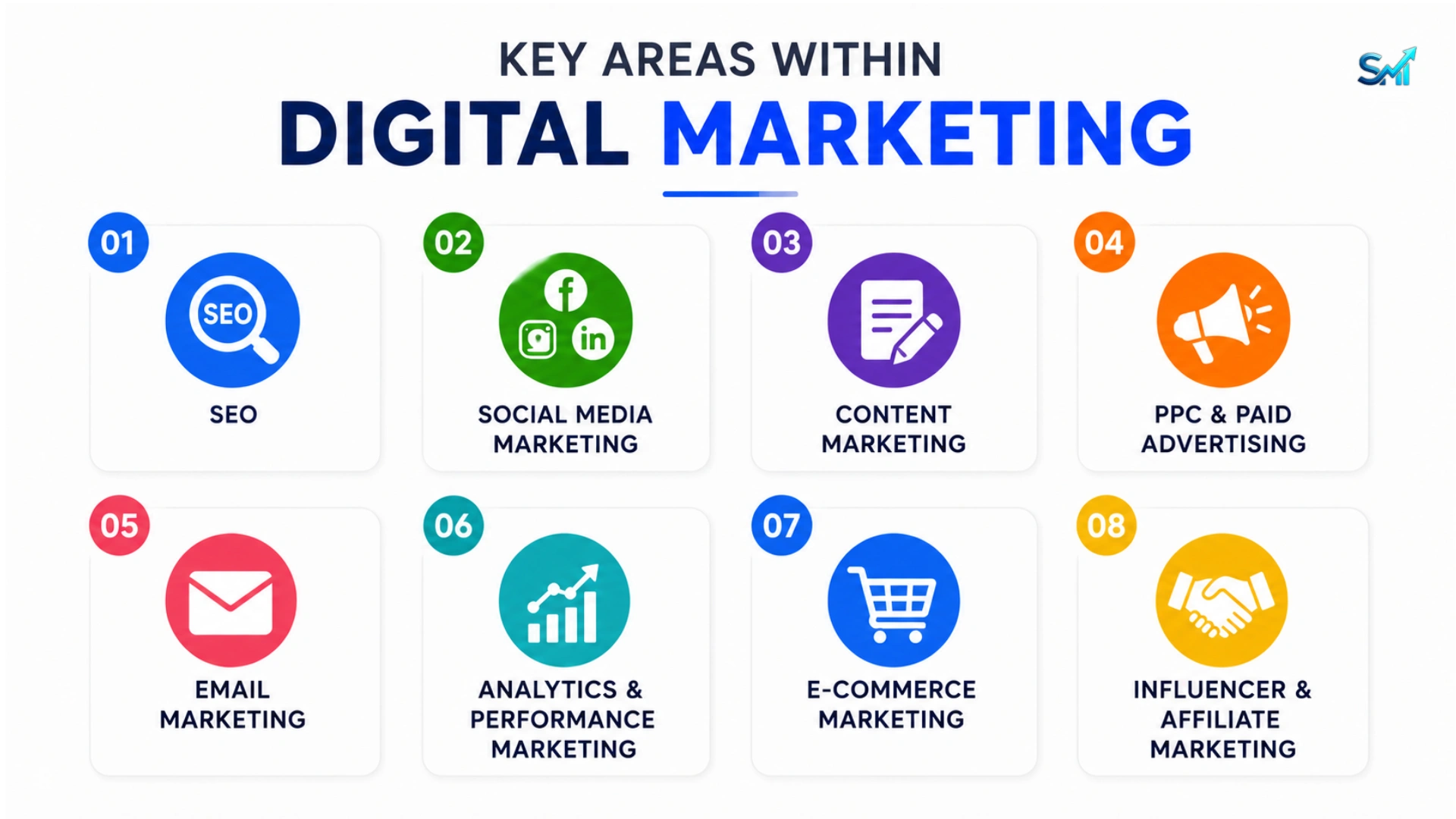
To truly understand the scope of digital marketing, it helps to look at its major branches. Each of these is a career path and a business function on its own.
Search Engine Optimization (SEO)
Enhancing a website to rank higher on search engines like Google is known as SEO. Since most people don’t scroll past the first page of search results, businesses invest heavily in SEO to get found. SEO includes keyword research, on-page optimization, technical fixes, link building, and content strategy. As search engines evolve with AI-driven results, SEO professionals who understand these changes will remain in high demand, making SEO one of the most valuable skill sets within the scope of digital marketing.
Pay-Per-Click (PPC) and Search Engine Marketing (SEM) Promotion
While SEO is about earning traffic organically, SEM is about paying for visibility through platforms like Google Ads. PPC specialists manage ad campaigns, control budgets, write ad copy, and analyze performance to make sure every rupee or dollar spent brings a return. This is a highly measurable and results-driven area of digital marketing.
Social Media Marketing
Platforms like Instagram, Facebook, LinkedIn, and YouTube have become essential marketing channels. Social media marketers create content, run paid campaigns, engage with audiences, and build brand communities. This area also includes influencer marketing, which has grown into a multi-billion-dollar industry of its own.
Content Marketing
The majority of digital marketing tactics are built on content. Blogs, videos, infographics, podcasts, and case studies help businesses educate their audience, build trust, and rank on search engines. Skilled content marketers combine storytelling with strategy to move people from awareness to purchase.
Email Marketing
Email marketing is still one of the most profitable tactics accessible, even if it’s an older digital medium. Businesses use email to nurture leads, announce products, and retain existing customers through personalized, automated campaigns.
Affiliate and Influencer Marketing
Businesses partner with individuals or other websites to promote their products in exchange for a commission or fee. This performance-based model has grown rapidly because it’s low-risk for the business and rewarding for the affiliate or influencer.
Marketing Analytics and Data
Every digital campaign generates data, and businesses need people who can interpret that data to make smarter decisions. Analytics professionals track website traffic, conversion rates, customer behavior, and campaign performance, turning numbers into actionable strategy.
Web Design and Conversion Rate Optimization (CRO)
A great marketing campaign can still fail if the website itself doesn’t convert visitors into customers. This is why web design, user experience, and CRO have become closely tied to digital marketing. Small changes to a webpage’s layout, copy, or call-to-action can significantly increase conversions.
Career Opportunities in Digital Marketing
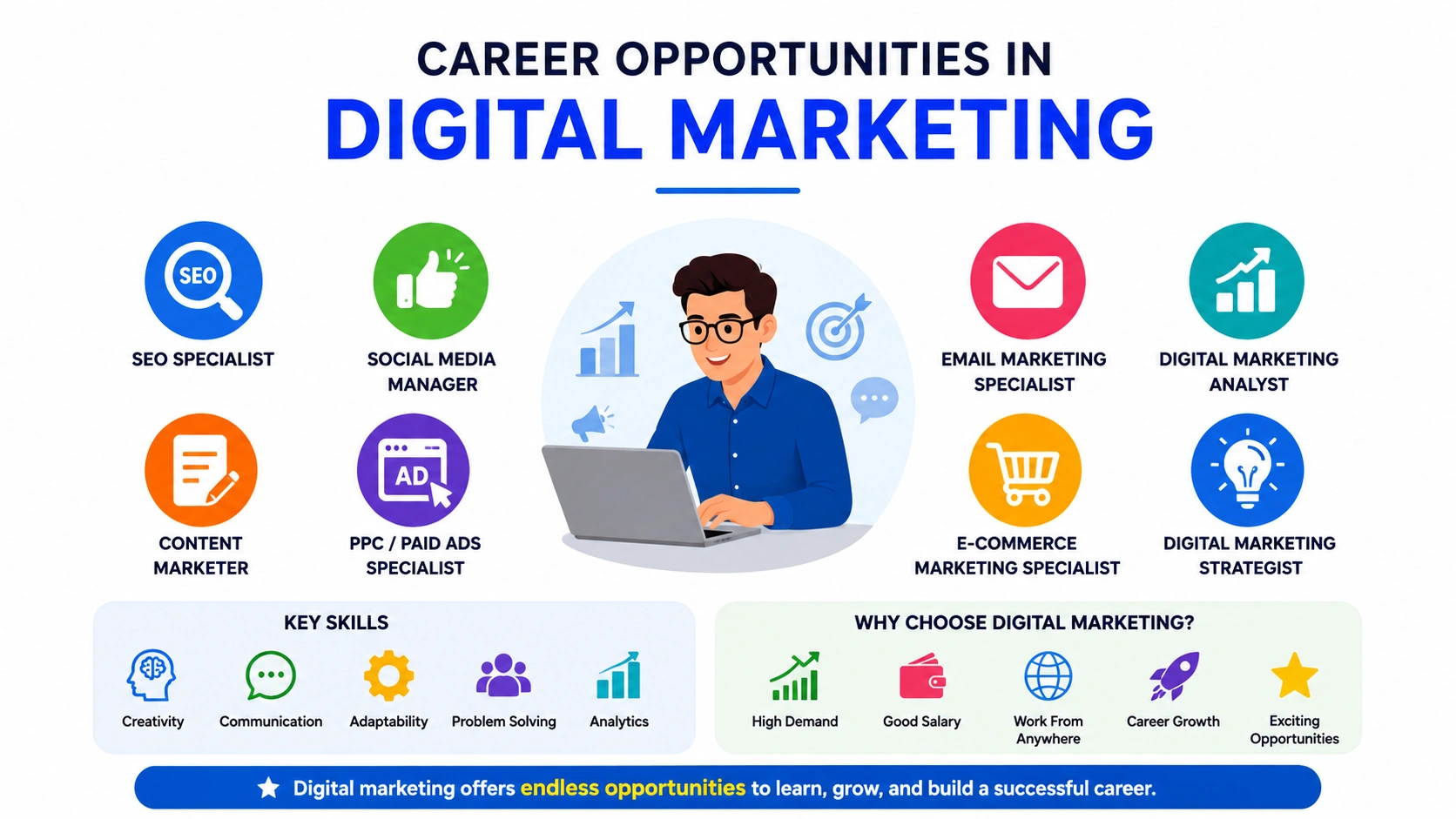
The scope of digital marketing as a career is extremely wide, offering roles for people with different skills and interests:
SEO specialist: making websites more search engine friendly
- PPC/Ads Manager – running and optimizing paid ad campaigns
- Social Media Manager – handling brand presence on socialplatforms
- Content Writer/Strategist –creatingcontent that attracts and converts
- Email Marketing Specialist – building and managing email campaigns
- Digital Marketing Analyst – interpreting data to guide strategy
- Digital Marketing Manager – overseeing entire marketing strategies across channels
- Freelance Digital Marketer – offering specialized services to multiple clients independently
- Digital Marketing Consultant – advising businesses on strategy and growth
What makes this field especially attractive is that you don’t need a specific degree to enter it. Many successful digital marketers are self-taught or trained through short-term courses, certifications, and hands-on project experience. Platforms like Google, Meta, and HubSpot offer free certifications that are widely recognized in the industry.
Scope of Digital Marketing for Businesses
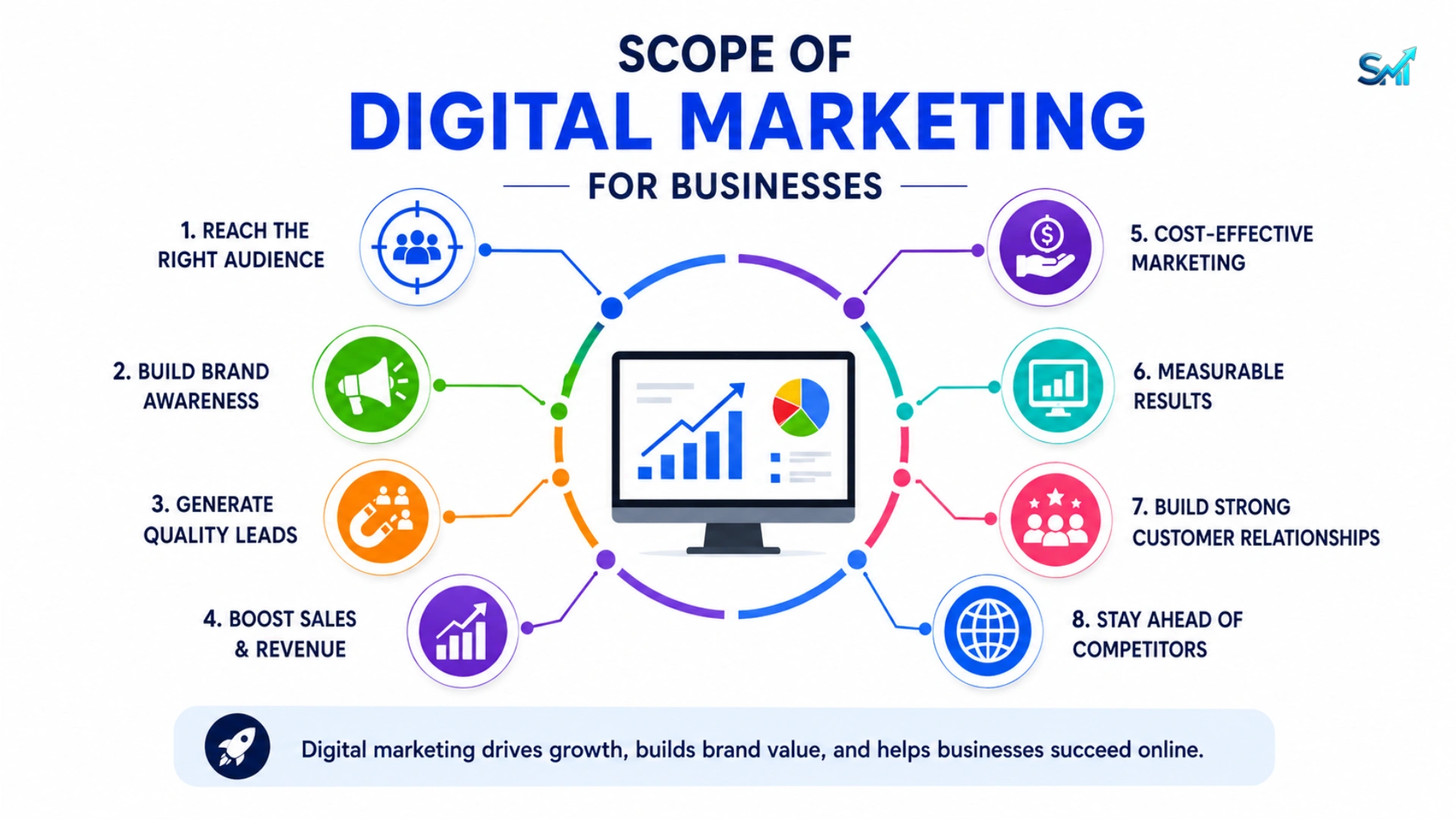
For businesses, digital marketing isn’t optional anymore, it’s a necessity. Here’s why:
Wider reach at lower cost: A single social media post or well-optimized blog can reach thousands of potential customers without the massive budgets traditional media required.
Precise targeting: Digital platforms allow businesses to target audiences based on age, location, interests, behavior, and even purchase history, ensuring marketing dollars aren’t wasted on uninterested audiences.
Real-time results and flexibility: Unlike a printed ad that runs for a fixed period regardless of performance, digital campaigns can be paused, tweaked, or scaled instantly based on real-time data.
Better customer relationships: Digital channels like email, social media, and chat allow businesses to interact directly with customers, answer questions, and build loyalty in ways traditional media never could.
Leveling the playing field: A small local business can now compete with larger companies by being smart and strategic online, something that was nearly impossible in the era of traditional advertising dominated by big budgets.
The Future Scope of Digital Marketing
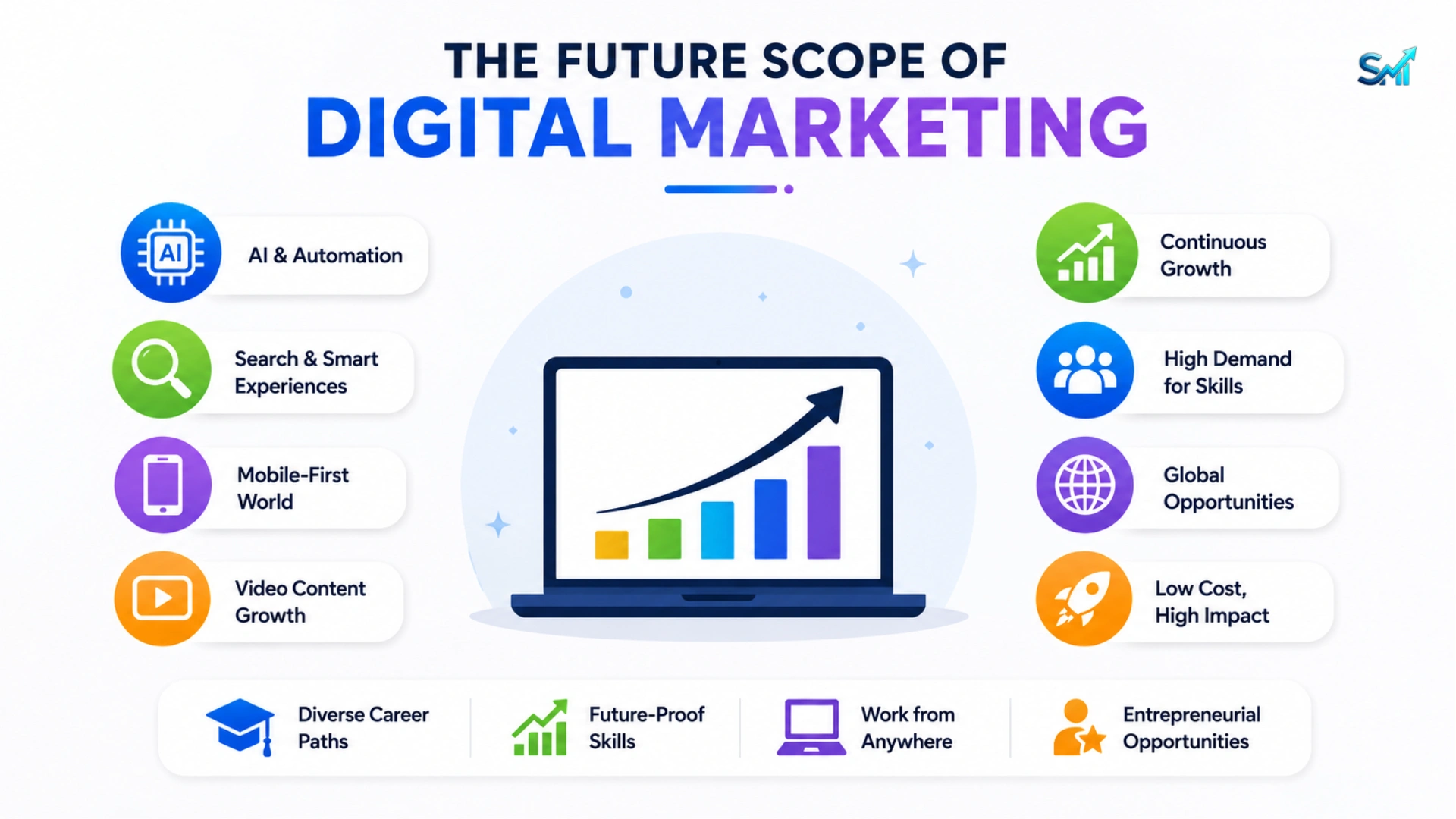
Looking ahead, several trends are set to shape and expand the field even further:
Artificial Intelligence and Automation: AI tools are helping marketers analyze data faster, personalize content, and automate repetitive tasks like ad bidding and email segmentation. Marketers who learn to work alongside AI tools will have a significant advantage.
Voice and Visual Search: As voice assistants and visual search tools become more common, SEO strategies are evolving to account for how people search using voice commands or images instead of typed text.
Short-Form Video Content: Platforms built around short videos have changed how brands tell stories and grab attention, pushing marketers to become skilled video content creators.
Personalization at Scale: Consumers now expect tailored experiences, from personalized product recommendations to customized email content. Marketers who can deliver this kind of personalization will stand out.
Privacy-First Marketing: As data privacy regulations tighten and third-party cookies phase out, marketers are shifting toward first-party data collection and more transparent, consent-based marketing strategies.
These trends show that the scope of digital marketing isn’t shrinking or becoming saturated, it’s evolving. New tools and platforms will keep creating new specializations and opportunities for people willing to keep learning.
Frequently Asked Question
1. What does digital marketing encompass?
The scope of digital marketing is broad and includes SEO, PPC advertising, social media marketing, content marketing, email marketing, affiliate marketing, analytics, web design, and conversion rate optimization.
2. Is digital marketing a good career in 2026?
Yes. Digital marketing offers a wide range of career opportunities, including SEO Specialist, PPC/Ads Manager, Social Media Manager, Content Strategist, Email Marketing Specialist, Digital Marketing Analyst, and Digital Marketing Manager.
3. Can I start a career in digital marketing without a degree?
Yes. A specific degree is not required to enter digital marketing. Many professionals learn through courses, certifications, self-study, and practical project experience.
4. What are digital marketing’s primary focus areas?
The main areas include SEO, SEM and PPC advertising, social media marketing, content marketing, email marketing, affiliate and influencer marketing, marketing analytics, web design, and CRO.
5. Is digital marketing suitable for freelancing?
Yes. Digital marketing is well suited to freelancing because many tasks can be performed online. Freelancers can work with multiple clients and serve businesses beyond their local area.
Conclusion
The scope of digital marketing spans far beyond just running a few social media ads or writing blog posts. It’s a vast, constantly evolving field that touches SEO, paid advertising, content creation, analytics, email marketing, and more. For businesses, it offers a cost-effective, measurable way to reach and convert customers. For individuals, it offers flexible, in-demand career paths that don’t require a traditional degree, only a willingness to learn and adapt.
As more of the world moves online and technology continues to advance, the scope of digital marketing keeps expanding — it isn’t just a trend, it’s the future of how businesses connect with people. Whether you’re planning to build a career in this field or grow your business through digital channels, now is one of the best times to invest in understanding and mastering the full scope of digital marketing.
Visit site for more Blogs